JBL Stage 245C (Unit): The Centre Channel That Makes Dialogue Clear
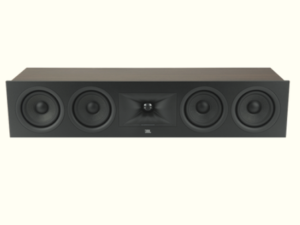
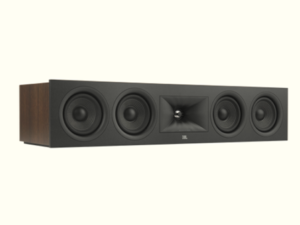
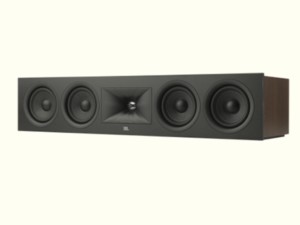
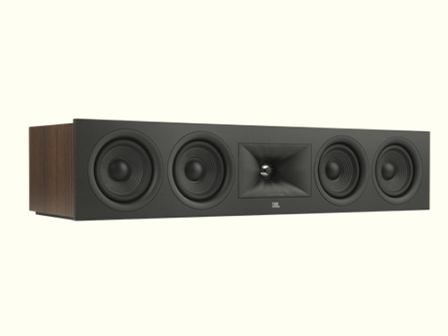
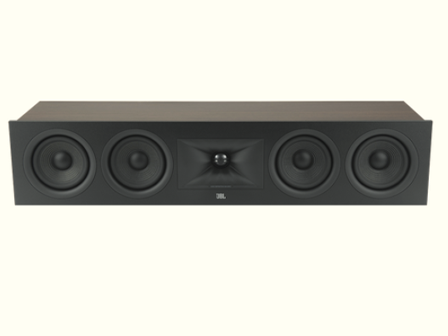
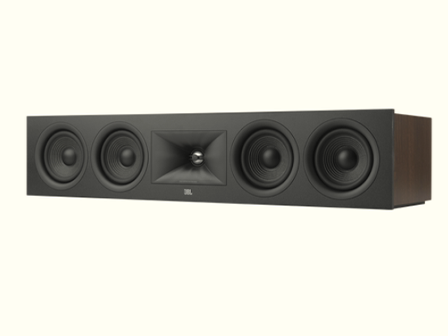
The JBL Stage 245C is the dedicated centre channel of the Stage 2 range, and in a home theatre it is arguably the hardest-working speaker you will buy. Designed at Harman’s Acoustic Engineering Center of Excellence in Northridge, California, it uses four 114 mm woofers arranged around a horn-loaded aluminium tweeter in a 2.5-way configuration. Sold as a single unit, it is voiced to blend with Stage 2 towers, bookshelf models and in-wall mains alike.
Why the JBL Stage 245C Deserves Your Attention
In a typical film mix, the majority of dialogue and a great deal of on-screen action are anchored to the centre channel. Upgrade your front left and right speakers while leaving a weak centre in place and the result is predictable: rich music, but voices that sit slightly recessed and force you to reach for the remote during quiet scenes.
That is the problem the JBL Stage 245C is built to solve. High sensitivity, a wide horizontal driver array and a crossover designed for off-axis consistency all serve one purpose — keeping speech intelligible for everyone in the room, not just the person sitting dead centre.
JBL Stage 245C Specifications at a Glance
| Specification | Detail |
|---|---|
| Type | 2.5-way centre channel loudspeaker |
| Low-frequency drivers | Quad 114 mm (4.5-inch) polycellulose ribbed cone |
| High-frequency driver | 25 mm (1-inch) anodised aluminium dome |
| Waveguide | Next-generation HDI horn |
| Frequency response (±6 dB) | 55 Hz – 25 kHz |
| Frequency response (±3 dB) | 82 Hz – 25 kHz |
| Sensitivity (1 m, 2.83 V) | 91 dB |
| Nominal impedance | 6 ohms |
| Crossover frequencies | 1.3 kHz / 2.0 kHz |
| RMS power handling | 75 W |
| Recommended amplifier power | 20 – 150 W |
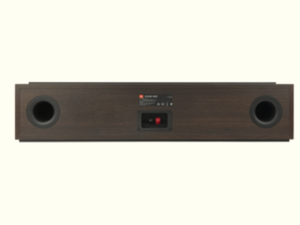
| Enclosure | Bass reflex, dual rear-firing flared ports |
| Terminals | 5-way binding posts |
| Dimensions (W × H × D) | Approx. 739 × 155 × 216 mm |
| Weight | 12.0 kg |
| Finishes | Espresso or Latte woodgrain |
| In the box | 1 speaker, 1 grille, 6 anti-slip pads, quick-start guide |
Figures are published by Harman and may be revised without notice. The official JBL product page and the downloadable Stage 245C spec sheet (PDF) carry the current data.
At 91 dB, the JBL Stage 245C is the most sensitive model in the Stage 2 range — a useful margin, since centre channels routinely handle the loudest, most dynamic content in a film mix.
How the Quad-Woofer Layout Widens the Sweet Spot
The problem with most centre channels
Conventional designs place two identical woofers either side of a tweeter, both reproducing the same frequencies. Because the two drivers are horizontally separated, their outputs arrive at slightly different times anywhere off the central axis, cancelling certain frequencies. The audible result is that dialogue thins out and loses body for anyone seated toward the ends of the sofa.
What the JBL Stage 245C does differently
The 2.5-way arrangement avoids this. The inner pair of woofers hands over to the tweeter just below its operating range, while the outer pair rolls off at a lower frequency and concentrates on bass. Only one pair is producing midrange at the point where cancellation would otherwise occur, so the usable listening area widens considerably. In an Indian living room with an L-shaped sofa and viewers spread across three or four seats, that is a meaningful practical benefit rather than a specification-sheet footnote.
HDI waveguide and aluminium tweeter
The waveguide controls how treble disperses horizontally, keeping consonants crisp across a wide arc. Combined with the crossover design above, it means the JBL Stage 245C delivers a tonal balance at the far end of the seating close to what the central seat receives. Air-core inductors and Mylar capacitors handle the high-frequency section, with laminate-core inductors and electrolytic capacitors below.
Will It Fit? Two Checks Before You Order
Measure your cabinet width. The JBL Stage 245C is a genuinely wide speaker at roughly 739 mm. Most Indian TV consoles have a central compartment considerably narrower than that, so measure before ordering rather than after.
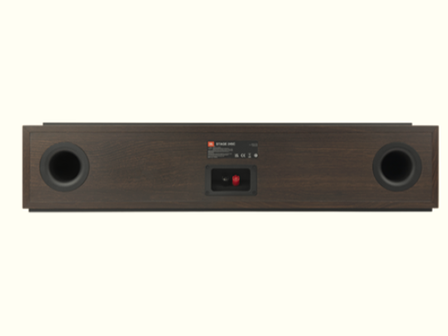
Check for rear clearance. The JBL Stage 245C is rear-ported, which means it cannot be pushed into a closed cabinet compartment. Enclosed shelving chokes the ports and produces boomy, indistinct dialogue — exactly the opposite of what you bought it for. Leave at least 15–20 cm of open space behind the cabinet, or place it on an open shelf or a dedicated stand below the television.
Placement and Angling for Indian Living Rooms
Position the speaker directly below or above the screen, horizontally centred on it. If the JBL Stage 245C sits substantially below seated ear height — common when a television is wall-mounted high — tilt the cabinet upward so the tweeter aims toward the listening position. A slim wedge or an adjustable stand achieves this easily.
Dolby recommends keeping listener-level speakers close to seated ear height, roughly 1.2 metres; the official Dolby speaker setup guide covers the full geometry. Six anti-slip pads are supplied to stop the cabinet creeping on polished stone or glass surfaces, and a rug between the seating and the front stage will reduce the floor reflections that blur speech in tiled rooms.
Amplifier and Receiver Matching
At 91 dB sensitivity into 6 ohms, the JBL Stage 245C is easy to drive. Any AV receiver supplying 60–150 W per channel will do the job comfortably.
- Set the crossover at 80–100 Hz in your receiver, and let the subwoofer handle everything below.
- Run room correction after installation. Audyssey, YPAO or Dirac Live will set distance and level accurately — critical for a centre channel, where a small level error directly affects dialogue intelligibility.
- Match the impedance selector if your receiver offers one.
- Nudge the centre level up by 1–2 dB after calibration if dialogue still feels recessed. This is normal and perfectly acceptable.
Who Should Buy the JBL Stage 245C?
A strong match if you already own or plan to buy Stage 2 mains, watch a lot of dialogue-driven content, have a wide seating arrangement, or are upgrading a system where speech clarity is the weak link.
Look elsewhere if you have a TV console narrower than 750 mm with no alternative placement, need a speaker that can sit inside a closed cabinet, or are building a stereo-only music system where no centre channel is required.
Frequently Asked Questions
Is the JBL Stage 245C sold individually?
Yes. A home theatre needs only one centre channel, so this listing covers a single unit.
Can it be used with non-JBL front speakers?
It will work, but timbre matching is the entire point of a centre channel. Pairing it with Stage 2 mains gives the most seamless result across the front three channels.
Does it need a subwoofer?
For films, yes. Response rolls off below 82 Hz, and a subwoofer such as the Stage 220P will handle low-frequency effects while freeing the centre channel to focus on dialogue.
Can it be wall-mounted?
No mounting hardware is supplied, and the rear ports need clearance. A shelf, stand or console with open space behind it is the appropriate placement.
JBL Stage 245C (Unit): The Centre Channel That Makes Dialogue Clear
The JBL Stage 245C is the dedicated centre channel of the Stage 2 range, and in a home theatre it is arguably the hardest-working speaker you will buy. Designed at Harman’s Acoustic Engineering Center of Excellence in Northridge, California, it uses four 114 mm woofers arranged around a horn-loaded aluminium tweeter in a 2.5-way configuration. Sold as a single unit, it is voiced to blend with Stage 2 towers, bookshelf models and in-wall mains alike.
Why the JBL Stage 245C Deserves Your Attention
In a typical film mix, the majority of dialogue and a great deal of on-screen action are anchored to the centre channel. Upgrade your front left and right speakers while leaving a weak centre in place and the result is predictable: rich music, but voices that sit slightly recessed and force you to reach for the remote during quiet scenes.
That is the problem the JBL Stage 245C is built to solve. High sensitivity, a wide horizontal driver array and a crossover designed for off-axis consistency all serve one purpose — keeping speech intelligible for everyone in the room, not just the person sitting dead centre.
JBL Stage 245C Specifications at a Glance
| Specification | Detail |
|---|---|
| Type | 2.5-way centre channel loudspeaker |
| Low-frequency drivers | Quad 114 mm (4.5-inch) polycellulose ribbed cone |
| High-frequency driver | 25 mm (1-inch) anodised aluminium dome |
| Waveguide | Next-generation HDI horn |
| Frequency response (±6 dB) | 55 Hz – 25 kHz |
| Frequency response (±3 dB) | 82 Hz – 25 kHz |
| Sensitivity (1 m, 2.83 V) | 91 dB |
| Nominal impedance | 6 ohms |
| Crossover frequencies | 1.3 kHz / 2.0 kHz |
| RMS power handling | 75 W |
| Recommended amplifier power | 20 – 150 W |
| Enclosure | Bass reflex, dual rear-firing flared ports |
| Terminals | 5-way binding posts |
| Dimensions (W × H × D) | Approx. 739 × 155 × 216 mm |
| Weight | 12.0 kg |
| Finishes | Espresso or Latte woodgrain |
| In the box | 1 speaker, 1 grille, 6 anti-slip pads, quick-start guide |
Figures are published by Harman and may be revised without notice. The official JBL product page and the downloadable Stage 245C spec sheet (PDF) carry the current data.
At 91 dB, the JBL Stage 245C is the most sensitive model in the Stage 2 range — a useful margin, since centre channels routinely handle the loudest, most dynamic content in a film mix.
How the Quad-Woofer Layout Widens the Sweet Spot
The problem with most centre channels
Conventional designs place two identical woofers either side of a tweeter, both reproducing the same frequencies. Because the two drivers are horizontally separated, their outputs arrive at slightly different times anywhere off the central axis, cancelling certain frequencies. The audible result is that dialogue thins out and loses body for anyone seated toward the ends of the sofa.
What the JBL Stage 245C does differently
The 2.5-way arrangement avoids this. The inner pair of woofers hands over to the tweeter just below its operating range, while the outer pair rolls off at a lower frequency and concentrates on bass. Only one pair is producing midrange at the point where cancellation would otherwise occur, so the usable listening area widens considerably. In an Indian living room with an L-shaped sofa and viewers spread across three or four seats, that is a meaningful practical benefit rather than a specification-sheet footnote.
HDI waveguide and aluminium tweeter
The waveguide controls how treble disperses horizontally, keeping consonants crisp across a wide arc. Combined with the crossover design above, it means the JBL Stage 245C delivers a tonal balance at the far end of the seating close to what the central seat receives. Air-core inductors and Mylar capacitors handle the high-frequency section, with laminate-core inductors and electrolytic capacitors below.
Will It Fit? Two Checks Before You Order
Measure your cabinet width. The JBL Stage 245C is a genuinely wide speaker at roughly 739 mm. Most Indian TV consoles have a central compartment considerably narrower than that, so measure before ordering rather than after.
Check for rear clearance. The JBL Stage 245C is rear-ported, which means it cannot be pushed into a closed cabinet compartment. Enclosed shelving chokes the ports and produces boomy, indistinct dialogue — exactly the opposite of what you bought it for. Leave at least 15–20 cm of open space behind the cabinet, or place it on an open shelf or a dedicated stand below the television.
Placement and Angling for Indian Living Rooms
Position the speaker directly below or above the screen, horizontally centred on it. If the JBL Stage 245C sits substantially below seated ear height — common when a television is wall-mounted high — tilt the cabinet upward so the tweeter aims toward the listening position. A slim wedge or an adjustable stand achieves this easily.
Dolby recommends keeping listener-level speakers close to seated ear height, roughly 1.2 metres; the official Dolby speaker setup guide covers the full geometry. Six anti-slip pads are supplied to stop the cabinet creeping on polished stone or glass surfaces, and a rug between the seating and the front stage will reduce the floor reflections that blur speech in tiled rooms.
Amplifier and Receiver Matching
At 91 dB sensitivity into 6 ohms, the JBL Stage 245C is easy to drive. Any AV receiver supplying 60–150 W per channel will do the job comfortably.
- Set the crossover at 80–100 Hz in your receiver, and let the subwoofer handle everything below.
- Run room correction after installation. Audyssey, YPAO or Dirac Live will set distance and level accurately — critical for a centre channel, where a small level error directly affects dialogue intelligibility.
- Match the impedance selector if your receiver offers one.
- Nudge the centre level up by 1–2 dB after calibration if dialogue still feels recessed. This is normal and perfectly acceptable.
Who Should Buy the JBL Stage 245C?
A strong match if you already own or plan to buy Stage 2 mains, watch a lot of dialogue-driven content, have a wide seating arrangement, or are upgrading a system where speech clarity is the weak link.
Look elsewhere if you have a TV console narrower than 750 mm with no alternative placement, need a speaker that can sit inside a closed cabinet, or are building a stereo-only music system where no centre channel is required.
Frequently Asked Questions
Is the JBL Stage 245C sold individually?
Yes. A home theatre needs only one centre channel, so this listing covers a single unit.
Can it be used with non-JBL front speakers?
It will work, but timbre matching is the entire point of a centre channel. Pairing it with Stage 2 mains gives the most seamless result across the front three channels.
Does it need a subwoofer?
For films, yes. Response rolls off below 82 Hz, and a subwoofer such as the Stage 220P will handle low-frequency effects while freeing the centre channel to focus on dialogue.
Can it be wall-mounted?
No mounting hardware is supplied, and the rear ports need clearance. A shelf, stand or console with open space behind it is the appropriate placement.
JBL Stage 245C (Unit): The Centre Channel That Makes Dialogue Clear
The JBL Stage 245C is the dedicated centre channel of the Stage 2 range, and in a home theatre it is arguably the hardest-working speaker you will buy. Designed at Harman’s Acoustic Engineering Center of Excellence in Northridge, California, it uses four 114 mm woofers arranged around a horn-loaded aluminium tweeter in a 2.5-way configuration. Sold as a single unit, it is voiced to blend with Stage 2 towers, bookshelf models and in-wall mains alike.
Why the JBL Stage 245C Deserves Your Attention
In a typical film mix, the majority of dialogue and a great deal of on-screen action are anchored to the centre channel. Upgrade your front left and right speakers while leaving a weak centre in place and the result is predictable: rich music, but voices that sit slightly recessed and force you to reach for the remote during quiet scenes.
That is the problem the JBL Stage 245C is built to solve. High sensitivity, a wide horizontal driver array and a crossover designed for off-axis consistency all serve one purpose — keeping speech intelligible for everyone in the room, not just the person sitting dead centre.
JBL Stage 245C Specifications at a Glance
| Specification | Detail |
|---|---|
| Type | 2.5-way centre channel loudspeaker |
| Low-frequency drivers | Quad 114 mm (4.5-inch) polycellulose ribbed cone |
| High-frequency driver | 25 mm (1-inch) anodised aluminium dome |
| Waveguide | Next-generation HDI horn |
| Frequency response (±6 dB) | 55 Hz – 25 kHz |
| Frequency response (±3 dB) | 82 Hz – 25 kHz |
| Sensitivity (1 m, 2.83 V) | 91 dB |
| Nominal impedance | 6 ohms |
| Crossover frequencies | 1.3 kHz / 2.0 kHz |
| RMS power handling | 75 W |
| Recommended amplifier power | 20 – 150 W |
| Enclosure | Bass reflex, dual rear-firing flared ports |
| Terminals | 5-way binding posts |
| Dimensions (W × H × D) | Approx. 739 × 155 × 216 mm |
| Weight | 12.0 kg |
| Finishes | Espresso or Latte woodgrain |
| In the box | 1 speaker, 1 grille, 6 anti-slip pads, quick-start guide |
Figures are published by Harman and may be revised without notice. The official JBL product page and the downloadable Stage 245C spec sheet (PDF) carry the current data.
At 91 dB, the JBL Stage 245C is the most sensitive model in the Stage 2 range — a useful margin, since centre channels routinely handle the loudest, most dynamic content in a film mix.
How the Quad-Woofer Layout Widens the Sweet Spot
The problem with most centre channels
Conventional designs place two identical woofers either side of a tweeter, both reproducing the same frequencies. Because the two drivers are horizontally separated, their outputs arrive at slightly different times anywhere off the central axis, cancelling certain frequencies. The audible result is that dialogue thins out and loses body for anyone seated toward the ends of the sofa.
What the JBL Stage 245C does differently
The 2.5-way arrangement avoids this. The inner pair of woofers hands over to the tweeter just below its operating range, while the outer pair rolls off at a lower frequency and concentrates on bass. Only one pair is producing midrange at the point where cancellation would otherwise occur, so the usable listening area widens considerably. In an Indian living room with an L-shaped sofa and viewers spread across three or four seats, that is a meaningful practical benefit rather than a specification-sheet footnote.
HDI waveguide and aluminium tweeter
The waveguide controls how treble disperses horizontally, keeping consonants crisp across a wide arc. Combined with the crossover design above, it means the JBL Stage 245C delivers a tonal balance at the far end of the seating close to what the central seat receives. Air-core inductors and Mylar capacitors handle the high-frequency section, with laminate-core inductors and electrolytic capacitors below.
Will It Fit? Two Checks Before You Order
Measure your cabinet width. The JBL Stage 245C is a genuinely wide speaker at roughly 739 mm. Most Indian TV consoles have a central compartment considerably narrower than that, so measure before ordering rather than after.
Check for rear clearance. The JBL Stage 245C is rear-ported, which means it cannot be pushed into a closed cabinet compartment. Enclosed shelving chokes the ports and produces boomy, indistinct dialogue — exactly the opposite of what you bought it for. Leave at least 15–20 cm of open space behind the cabinet, or place it on an open shelf or a dedicated stand below the television.
Placement and Angling for Indian Living Rooms
Position the speaker directly below or above the screen, horizontally centred on it. If the JBL Stage 245C sits substantially below seated ear height — common when a television is wall-mounted high — tilt the cabinet upward so the tweeter aims toward the listening position. A slim wedge or an adjustable stand achieves this easily.
Dolby recommends keeping listener-level speakers close to seated ear height, roughly 1.2 metres; the official Dolby speaker setup guide covers the full geometry. Six anti-slip pads are supplied to stop the cabinet creeping on polished stone or glass surfaces, and a rug between the seating and the front stage will reduce the floor reflections that blur speech in tiled rooms.
Amplifier and Receiver Matching
At 91 dB sensitivity into 6 ohms, the JBL Stage 245C is easy to drive. Any AV receiver supplying 60–150 W per channel will do the job comfortably.
- Set the crossover at 80–100 Hz in your receiver, and let the subwoofer handle everything below.
- Run room correction after installation. Audyssey, YPAO or Dirac Live will set distance and level accurately — critical for a centre channel, where a small level error directly affects dialogue intelligibility.
- Match the impedance selector if your receiver offers one.
- Nudge the centre level up by 1–2 dB after calibration if dialogue still feels recessed. This is normal and perfectly acceptable.
Who Should Buy the JBL Stage 245C?
A strong match if you already own or plan to buy Stage 2 mains, watch a lot of dialogue-driven content, have a wide seating arrangement, or are upgrading a system where speech clarity is the weak link.
Look elsewhere if you have a TV console narrower than 750 mm with no alternative placement, need a speaker that can sit inside a closed cabinet, or are building a stereo-only music system where no centre channel is required.
Frequently Asked Questions
Is the JBL Stage 245C sold individually?
Yes. A home theatre needs only one centre channel, so this listing covers a single unit.
Can it be used with non-JBL front speakers?
It will work, but timbre matching is the entire point of a centre channel. Pairing it with Stage 2 mains gives the most seamless result across the front three channels.
Does it need a subwoofer?
For films, yes. Response rolls off below 82 Hz, and a subwoofer such as the Stage 220P will handle low-frequency effects while freeing the centre channel to focus on dialogue.
Can it be wall-mounted?
No mounting hardware is supplied, and the rear ports need clearance. A shelf, stand or console with open space behind it is the appropriate placement.