JBL Stage 240B (Pair): Small Speakers, Full-Size JBL Character
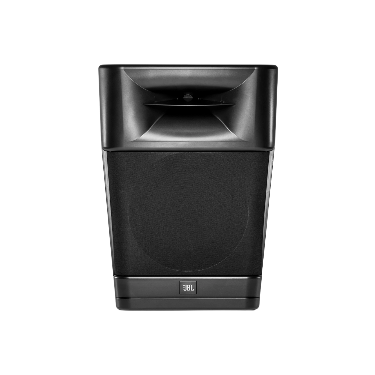
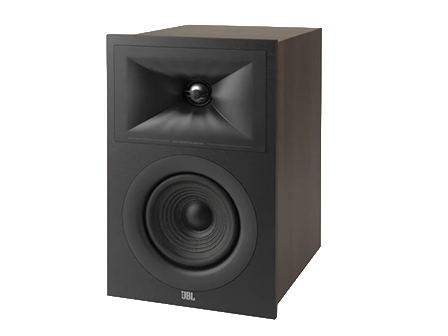
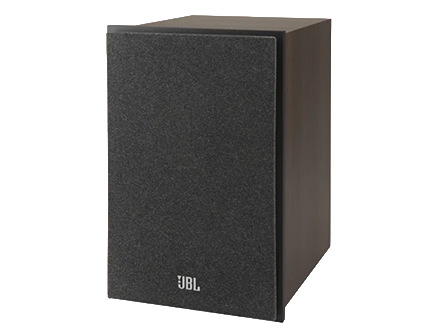
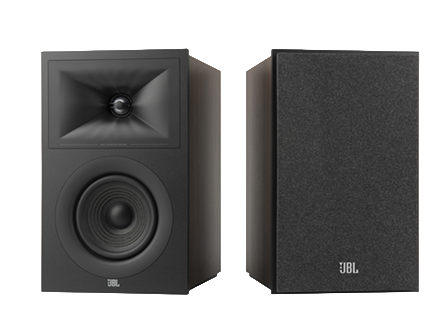
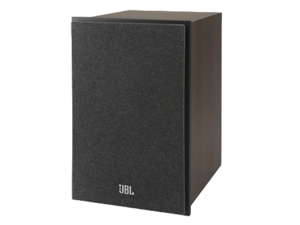
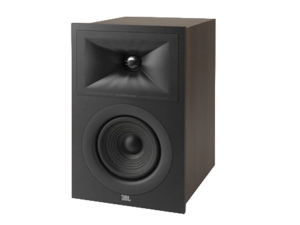
The JBL Stage 240B is the most compact loudspeaker in the Stage 2 family, and it is also the most flexible. Sold as a pair, it packs a 114 mm woofer and a horn-loaded aluminium tweeter into a cabinet under 11 inches tall — small enough for a console table, a study shelf or a wall bracket behind the sofa. Designed at Harman’s Acoustic Engineering Center of Excellence in Northridge, California, it is built for people who want proper hi-fi voicing where a larger speaker simply will not fit.
Where the JBL Stage 240B Fits in the Stage 2 Range
Choosing between the three passive models in this series is mostly a question of room size and role.
| Model | Woofer | Low-end reach | Sensitivity | Best suited to |
|---|---|---|---|---|
| Stage 240B | 114 mm | 53 Hz | 85 dB | Small rooms, surrounds, wall mounting |
| Stage 250B | 130 mm | 50 Hz | 86 dB | Medium rooms, stands, stereo mains |
| Stage 260F | Dual 165 mm | 40 Hz | 90 dB | Larger rooms, front left and right towers |
The JBL Stage 240B is not trying to be a tower speaker in miniature. Its advantage is placement freedom: it goes where nothing else will, and it shares its tweeter, waveguide and crossover philosophy with its larger siblings, so the tonal character stays consistent across an entire system.
JBL Stage 240B Specifications at a Glance
| Specification | Detail |
|---|---|
| Type | 2-way bass-reflex bookshelf loudspeaker |
| Low-frequency driver | 114 mm (4.5-inch) polycellulose ribbed cone |
| High-frequency driver | 25 mm (1-inch) anodised aluminium dome |
| Waveguide | Next-generation HDI horn |
| Frequency response (±6 dB) | 53 Hz – 25 kHz |
| Sensitivity (1 m, 2.83 V) | 85 dB |
| Nominal impedance | 6 ohms |
| Crossover frequency | 1.4 kHz |
| Recommended amplifier power | 20 – 125 W |
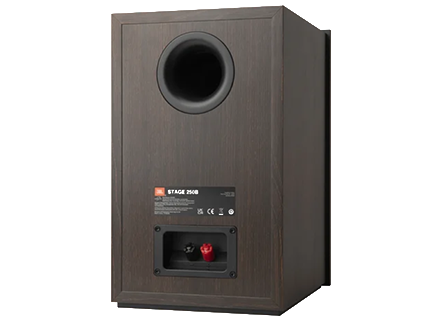
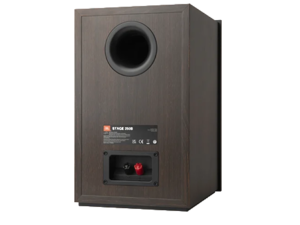
| Enclosure | Bass reflex, rear-firing flared port |
| Terminals | 5-way binding posts |
| Mounting | Integrated wall bracket plus 1/4-20 threaded insert |
| Dimensions (H × W × D) | 272 × 175 × 217 mm |
| Weight | 4.6 kg each |
| Finishes | Espresso or Latte woodgrain |
| In the box | 2 speakers, 2 grilles, 2 wall brackets, 8 mounting screws, 8 anti-slip pads, 2 foam port plugs, quick-start guide |
Figures are published by Harman and may be revised without notice. The current datasheet is available from the official JBL product page, and the printable Stage 240B spec sheet (PDF) lists the same data in full.
The Engineering That Makes a Small Cabinet Work
Polycellulose ribbed cone woofer
A 114 mm driver has very little air to move, so cone rigidity matters more on the JBL Stage 240B than on a larger model. The pure pulp cone is blended with additional materials for stiffness, and the ribbed profile — a visual signature borrowed from classic JBL monitors — resists flex as excursion increases. The result is midrange that stays clean at volume instead of hardening.
HDI waveguide and aluminium dome tweeter
The waveguide occupies most of the upper baffle, which is unusual on a speaker this size. Controlling dispersion this deliberately means the JBL Stage 240B maintains a consistent tonal balance off-axis, so listeners seated at the edges of the room hear roughly what the person in the middle hears. On a small speaker that is often mounted high on a wall or tucked into a corner, that consistency is worth more than an extra decibel of bass.
Precision 2-way crossover
The JBL Stage 240B splits its crossover at 1.4 kHz — lower than its larger siblings, because the small woofer hands over to the tweeter earlier. Air-core inductors and Mylar capacitors handle the high-frequency section, with laminate-core inductors and electrolytic capacitors below. These are not the components normally fitted at this price.
Mounting Options: The Real Advantage
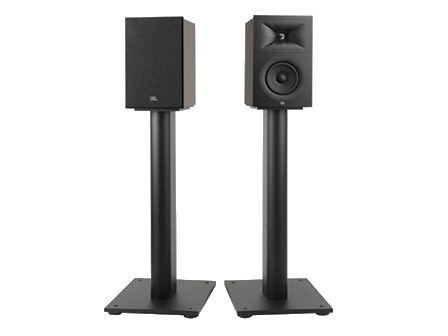
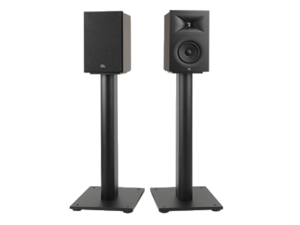
This is where the JBL Stage 240B separates itself from most compact speakers. Wall brackets and mounting screws are supplied in the box, and each cabinet also carries an industry-standard 1/4-20 threaded insert for aftermarket brackets and stands. Optional JBL FL floorstands are available if you would rather raise them off a surface.
Two foam port plugs are also included with the JBL Stage 240B. Fitting them damps the rear port when a speaker has to sit close to a wall, trading a little bass extension for cleaner, less boomy output. Anyone mounting these in a tight corner or on a bracket near a ceiling should try the plugs before assuming the bass is wrong.
Using the JBL Stage 240B as Surround Channels
Rear and side channels rarely need to play deep bass — the subwoofer and the front speakers handle that. What they need is accurate timbre so that a sound panning from front to rear does not visibly change character halfway across the room.
Because the JBL Stage 240B shares its tweeter, waveguide geometry and crossover components with the wider Stage 2 range, it timbre-matches cleanly with the 250B bookshelf pair or the 260F and 280F towers. For a 5.1 or 5.1.2 system built in stages, that consistency is exactly what you want, and the included brackets remove the usual headache of finding side-wall placement in an Indian apartment.
Amplifier Matching for the JBL Stage 240B
At 85 dB sensitivity, this is the least efficient model in the series, so clean power matters. Aim for 40–100 W per channel into 6 ohms from a stereo amplifier or AV receiver.
- Avoid clipping. An underpowered amplifier pushed into distortion damages tweeters far more often than a larger, comfortable one.
- Set the impedance selector correctly if your receiver has one, to prevent thermal shutdowns during long sessions.
- Cross over at 80–100 Hz when running these with a subwoofer. Asking a 114 mm driver to reproduce deep bass wastes amplifier headroom.
- Run room correction. Audyssey, YPAO or Dirac Live will manage the reflections that hard Indian interiors introduce.
Placement Tips for Indian Homes
Leave at least 15–20 cm behind each JBL Stage 240B cabinet for the rear port to breathe, or fit the supplied foam plugs if that clearance is impossible. Ideal tweeter height is seated ear level, roughly 100–110 cm, though wall-mounted surrounds are normally placed higher and angled down toward the seating.
Toe the speakers inward so their axes converge just behind the listening position. A rug between you and the speakers will absorb early reflections from granite, marble or vitrified tile flooring and noticeably sharpen imaging. In humid coastal cities such as Chennai, Mumbai and Kochi, keep the cabinets off damp external walls and out of direct air-conditioner airflow.
Who Should Buy the JBL Stage 240B?
A strong match if you need surround channels that match a JBL front stage, are furnishing a compact bedroom or study system, have no floor space for stands, or want speakers that can be wall-mounted without buying extra hardware.
Look elsewhere if you want full-range sound without a subwoofer, are filling a large open-plan hall, or listen mainly to bass-heavy genres at high volume, where the 250B or the 260F towers would serve you far better.
Frequently Asked Questions
Is the JBL Stage 240B sold as a pair?
Yes — this model ships as a pair, including two wall brackets and two grilles. Confirm the quantity on the product page before checkout, since listings occasionally vary.
Does it need a subwoofer?
For films, yes. Rated response stops at 53 Hz, so a subwoofer such as the Stage 220P is strongly recommended for home theatre. For nearfield music listening in a small room, a pair on its own is perfectly satisfying.
Can it be wall-mounted without extra parts?
Yes. Brackets and screws are supplied, and the 1/4-20 insert accepts aftermarket mounts if you need a different angle or reach.
What warranty applies in India?
Authorised Harman dealers supply the standard manufacturer warranty. Grey-market imports are not serviceable in India, so purchase only through an authorised channel.
JBL Stage 240B (Pair): Small Speakers, Full-Size JBL Character
The JBL Stage 240B is the most compact loudspeaker in the Stage 2 family, and it is also the most flexible. Sold as a pair, it packs a 114 mm woofer and a horn-loaded aluminium tweeter into a cabinet under 11 inches tall — small enough for a console table, a study shelf or a wall bracket behind the sofa. Designed at Harman’s Acoustic Engineering Center of Excellence in Northridge, California, it is built for people who want proper hi-fi voicing where a larger speaker simply will not fit.
Where the JBL Stage 240B Fits in the Stage 2 Range
Choosing between the three passive models in this series is mostly a question of room size and role.
| Model | Woofer | Low-end reach | Sensitivity | Best suited to |
|---|---|---|---|---|
| Stage 240B | 114 mm | 53 Hz | 85 dB | Small rooms, surrounds, wall mounting |
| Stage 250B | 130 mm | 50 Hz | 86 dB | Medium rooms, stands, stereo mains |
| Stage 260F | Dual 165 mm | 40 Hz | 90 dB | Larger rooms, front left and right towers |
The JBL Stage 240B is not trying to be a tower speaker in miniature. Its advantage is placement freedom: it goes where nothing else will, and it shares its tweeter, waveguide and crossover philosophy with its larger siblings, so the tonal character stays consistent across an entire system.
JBL Stage 240B Specifications at a Glance
| Specification | Detail |
|---|---|
| Type | 2-way bass-reflex bookshelf loudspeaker |
| Low-frequency driver | 114 mm (4.5-inch) polycellulose ribbed cone |
| High-frequency driver | 25 mm (1-inch) anodised aluminium dome |
| Waveguide | Next-generation HDI horn |
| Frequency response (±6 dB) | 53 Hz – 25 kHz |
| Sensitivity (1 m, 2.83 V) | 85 dB |
| Nominal impedance | 6 ohms |
| Crossover frequency | 1.4 kHz |
| Recommended amplifier power | 20 – 125 W |
| Enclosure | Bass reflex, rear-firing flared port |
| Terminals | 5-way binding posts |
| Mounting | Integrated wall bracket plus 1/4-20 threaded insert |
| Dimensions (H × W × D) | 272 × 175 × 217 mm |
| Weight | 4.6 kg each |
| Finishes | Espresso or Latte woodgrain |
| In the box | 2 speakers, 2 grilles, 2 wall brackets, 8 mounting screws, 8 anti-slip pads, 2 foam port plugs, quick-start guide |
Figures are published by Harman and may be revised without notice. The current datasheet is available from the official JBL product page, and the printable Stage 240B spec sheet (PDF) lists the same data in full.
The Engineering That Makes a Small Cabinet Work
Polycellulose ribbed cone woofer
A 114 mm driver has very little air to move, so cone rigidity matters more on the JBL Stage 240B than on a larger model. The pure pulp cone is blended with additional materials for stiffness, and the ribbed profile — a visual signature borrowed from classic JBL monitors — resists flex as excursion increases. The result is midrange that stays clean at volume instead of hardening.
HDI waveguide and aluminium dome tweeter
The waveguide occupies most of the upper baffle, which is unusual on a speaker this size. Controlling dispersion this deliberately means the JBL Stage 240B maintains a consistent tonal balance off-axis, so listeners seated at the edges of the room hear roughly what the person in the middle hears. On a small speaker that is often mounted high on a wall or tucked into a corner, that consistency is worth more than an extra decibel of bass.
Precision 2-way crossover
The JBL Stage 240B splits its crossover at 1.4 kHz — lower than its larger siblings, because the small woofer hands over to the tweeter earlier. Air-core inductors and Mylar capacitors handle the high-frequency section, with laminate-core inductors and electrolytic capacitors below. These are not the components normally fitted at this price.
Mounting Options: The Real Advantage
This is where the JBL Stage 240B separates itself from most compact speakers. Wall brackets and mounting screws are supplied in the box, and each cabinet also carries an industry-standard 1/4-20 threaded insert for aftermarket brackets and stands. Optional JBL FL floorstands are available if you would rather raise them off a surface.
Two foam port plugs are also included with the JBL Stage 240B. Fitting them damps the rear port when a speaker has to sit close to a wall, trading a little bass extension for cleaner, less boomy output. Anyone mounting these in a tight corner or on a bracket near a ceiling should try the plugs before assuming the bass is wrong.
Using the JBL Stage 240B as Surround Channels
Rear and side channels rarely need to play deep bass — the subwoofer and the front speakers handle that. What they need is accurate timbre so that a sound panning from front to rear does not visibly change character halfway across the room.
Because the JBL Stage 240B shares its tweeter, waveguide geometry and crossover components with the wider Stage 2 range, it timbre-matches cleanly with the 250B bookshelf pair or the 260F and 280F towers. For a 5.1 or 5.1.2 system built in stages, that consistency is exactly what you want, and the included brackets remove the usual headache of finding side-wall placement in an Indian apartment.
Amplifier Matching for the JBL Stage 240B
At 85 dB sensitivity, this is the least efficient model in the series, so clean power matters. Aim for 40–100 W per channel into 6 ohms from a stereo amplifier or AV receiver.
- Avoid clipping. An underpowered amplifier pushed into distortion damages tweeters far more often than a larger, comfortable one.
- Set the impedance selector correctly if your receiver has one, to prevent thermal shutdowns during long sessions.
- Cross over at 80–100 Hz when running these with a subwoofer. Asking a 114 mm driver to reproduce deep bass wastes amplifier headroom.
- Run room correction. Audyssey, YPAO or Dirac Live will manage the reflections that hard Indian interiors introduce.
Placement Tips for Indian Homes
Leave at least 15–20 cm behind each JBL Stage 240B cabinet for the rear port to breathe, or fit the supplied foam plugs if that clearance is impossible. Ideal tweeter height is seated ear level, roughly 100–110 cm, though wall-mounted surrounds are normally placed higher and angled down toward the seating.
Toe the speakers inward so their axes converge just behind the listening position. A rug between you and the speakers will absorb early reflections from granite, marble or vitrified tile flooring and noticeably sharpen imaging. In humid coastal cities such as Chennai, Mumbai and Kochi, keep the cabinets off damp external walls and out of direct air-conditioner airflow.
Who Should Buy the JBL Stage 240B?
A strong match if you need surround channels that match a JBL front stage, are furnishing a compact bedroom or study system, have no floor space for stands, or want speakers that can be wall-mounted without buying extra hardware.
Look elsewhere if you want full-range sound without a subwoofer, are filling a large open-plan hall, or listen mainly to bass-heavy genres at high volume, where the 250B or the 260F towers would serve you far better.
Frequently Asked Questions
Is the JBL Stage 240B sold as a pair?
Yes — this model ships as a pair, including two wall brackets and two grilles. Confirm the quantity on the product page before checkout, since listings occasionally vary.
Does it need a subwoofer?
For films, yes. Rated response stops at 53 Hz, so a subwoofer such as the Stage 220P is strongly recommended for home theatre. For nearfield music listening in a small room, a pair on its own is perfectly satisfying.
Can it be wall-mounted without extra parts?
Yes. Brackets and screws are supplied, and the 1/4-20 insert accepts aftermarket mounts if you need a different angle or reach.
What warranty applies in India?
Authorised Harman dealers supply the standard manufacturer warranty. Grey-market imports are not serviceable in India, so purchase only through an authorised channel.