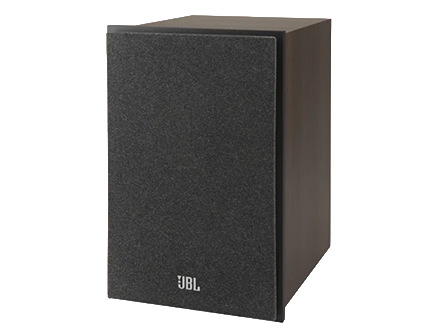
JBL Stage 250B: Compact Bookshelf Speakers with a Big JBL Voice
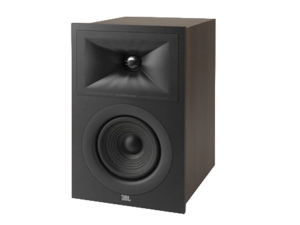
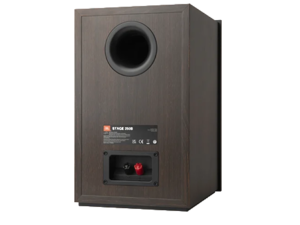
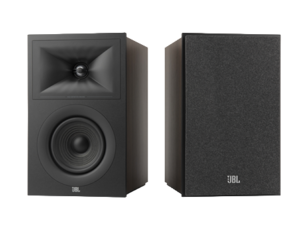
The JBL Stage 250B is the larger of the two bookshelf models in the Stage 2 range, and it exists for a specific kind of listener: someone who wants genuine hi-fi scale but does not have the floor space, or the domestic permission, for a pair of towers. Designed and engineered at Harman’s Acoustic Engineering Center of Excellence in Northridge, California, it packs a 130 mm woofer and a horn-loaded aluminium tweeter into a cabinet barely a foot tall. In a country where apartment living rooms are shrinking and every square foot counts, that trade-off makes a great deal of sense.
Why the JBL Stage 250B Punches Above Its Size
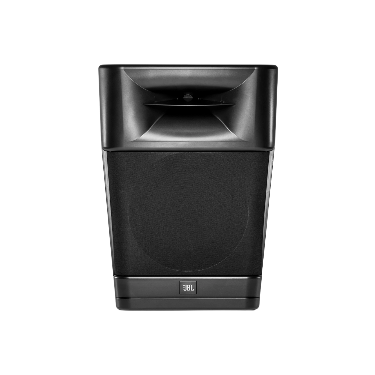
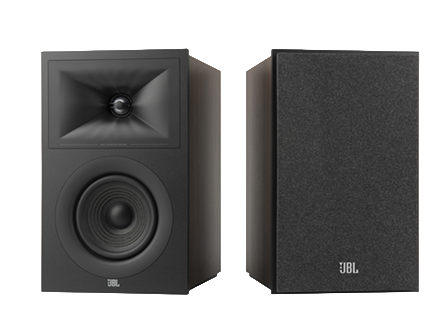
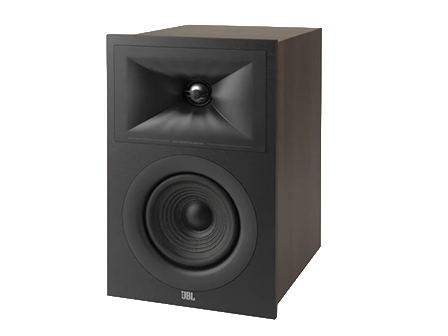
Small speakers usually give away two things: bass weight and dispersion. The JBL Stage 250B addresses the second problem head-on with a next-generation High-Definition Imaging (HDI) waveguide that occupies almost the entire upper baffle. A waveguide that large controls how treble spreads into the room, which means the JBL Stage 250B holds its stereo image even when you are not sitting in the acoustic sweet spot.
That matters more in real homes than any specification sheet suggests. Indian living rooms rarely allow textbook speaker placement — there is a dining table on one side, a balcony door on the other, and seating spread across an L-shaped sofa. A speaker with even off-axis response keeps vocals anchored and cymbals natural for everyone in the room, not just the person directly between the two cabinets.
JBL Stage 250B Specifications at a Glance
Here is how the JBL Stage 250B measures up on paper before you audition it.
| Specification | Detail |
|---|---|
| Type | 2-way bass-reflex bookshelf loudspeaker |
| Low-frequency driver | 130 mm (5.25-inch) polycellulose ribbed cone |
| High-frequency driver | 25 mm (1-inch) anodised aluminium dome |
| Waveguide | Next-generation HDI horn |
| Frequency response (±6 dB) | 50 Hz – 25 kHz |
| Frequency response (±3 dB) | 55 Hz – 25 kHz |
| Sensitivity (1 m, 2.83 V) | 86 dB |
| Nominal impedance | 6 ohms |
| Crossover frequency | 1.7 kHz |
| RMS power handling | 75 W |
| Recommended amplifier power | 20 – 150 W |
| Enclosure | Bass reflex, rear-firing flared port |
| Terminals | 5-way binding posts |
| Dimensions (H × W × D) | 321 × 200 × 241 mm |
| Weight | 5.6 kg each |
| Finishes | Espresso or Latte woodgrain |
| In the box | 2 speakers, 2 grilles, 8 self-adhesive pads, quick-start guide |
Specifications are published by Harman and may be revised without notice — always cross-check the current official Harman India product page before you place an order. The full technical datasheet and quick-start guide can be downloaded from the JBL global product listing.
The Acoustic Engineering Behind the Sound
Polycellulose ribbed cone woofer
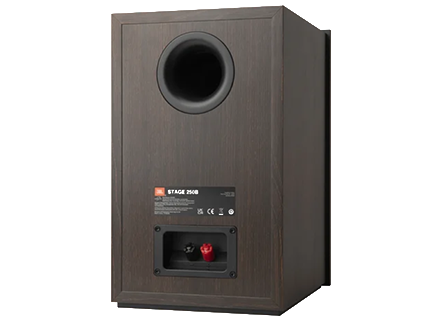
The woofer in the JBL Stage 250B uses a pure pulp cone blended with additional materials for rigidity, with a ribbed profile that visually echoes classic JBL studio monitors. A stiffer cone deforms less as it moves, so bass lines stay defined rather than smearing into the midrange. The rear-firing flared port extends low-frequency output and reduces the air turbulence that causes audible chuffing at higher volumes.
HDI waveguide and anodised aluminium tweeter
JBL reworked the horn geometry for the Stage 2 generation specifically to reduce diffraction and improve directivity. Practically speaking, the first sound wave that reaches your ears and the reflections that arrive milliseconds later share a similar tonal character. That coherence is what makes a small pair of speakers sound relaxed and open rather than sharp — an underrated advantage during long listening sessions.
Precision 2-way crossover
The JBL Stage 250B splits its crossover at 1.7 kHz using quality passive components: air-core inductors and Mylar capacitors on the high-frequency side, laminate-core inductors and electrolytic capacitors on the low-frequency side. These parts handle power with less loss and less distortion than the budget components typically fitted at this price level.
Build Quality, Finish and Everyday Details
The JBL Stage 250B carries design touches usually reserved for costlier models: a floating front baffle, trim rings around the drivers and magnetically attached grilles that leave no unsightly peg holes when removed. Espresso and Latte woodgrain finishes both work well against Indian interiors, the former with darker teak and rosewood furniture, the latter in lighter contemporary rooms.
Eight self-adhesive rubber pads are supplied to stop the cabinets sliding on polished stone or wooden surfaces and to reduce vibration transfer into whatever they are resting on. One honest caveat: the JBL Stage 250B has no integrated wall-mount bracket, so a wall installation requires third-party brackets rated for at least 6 kg per speaker.
Stereo Mains or Surrounds? Two Ways to Use It
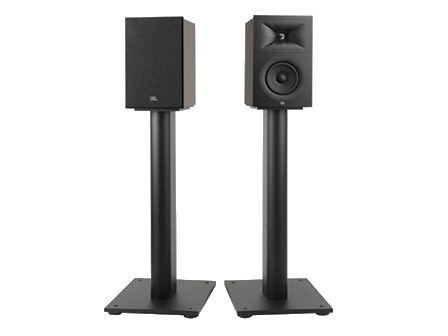
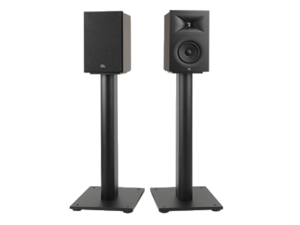
As a stereo pair on stands, the JBL Stage 250B serves as a capable main speaker for rooms up to roughly 200 square feet — enough for near-field listening, vinyl, streaming and casual movie nights. Add a subwoofer and you have a compact 2.1 system with genuine authority.
The second role is arguably where the JBL Stage 250B is most useful: as surround channels in a larger system. Because it shares drivers, waveguide design and voicing with the rest of the JBL Stage 2 bookshelf range, it timbre-matches cleanly with the Stage 260F or 280F towers up front. Consistent tonality across channels is what makes an object-based mix feel like one continuous soundfield rather than five separate speakers.
Matching an Amplifier to the JBL Stage 250B
At 86 dB sensitivity, this is a slightly less efficient design than the floorstanding models in the series, so it rewards clean power. Budget for 50–120 W per channel into 6 ohms from a competent stereo amplifier or AV receiver.
Practical pointers for Indian buyers:
- Do not under-power them. A small amplifier driven into clipping is far harder on tweeters than a larger amplifier running comfortably.
- Set the impedance correctly. If your receiver offers a 6-ohm/8-ohm selector, choose the right one to avoid thermal shutdowns.
- Run room correction. Audyssey, YPAO or Dirac Live will tame the bass reinforcement that concrete walls and tiled floors introduce.
- Use 14–16 AWG oxygen-free copper cable. Adequate gauge matters; exotic cabling does not.
Placement Tips That Make a Real Difference
The JBL Stage 250B fires its port rearwards, so a genuine bookshelf or a closed cabinet is the worst possible location. Leave at least 20–25 cm of clearance behind each cabinet, and use proper stands that place the tweeters at seated ear height — roughly 100–110 cm from the floor for most sofas.
Toe the speakers inward so their axes cross just behind your head, and keep them at equal distances from side walls where possible. In rooms with granite, marble or vitrified tile flooring, a rug between you and the speakers will absorb early reflections and noticeably tighten imaging. In humid coastal cities such as Chennai, Mumbai or Kochi, keep the cabinets away from damp external walls and out of the direct airflow of an air conditioner.
Who Should Buy the JBL Stage 250B?
A strong match if you live in an apartment where towers are impractical, want speakers that handle both music and film, are building a home theatre in stages and need timbre-matched surrounds, or are stepping up from a soundbar and want a real improvement in clarity and scale.
Look elsewhere if you need deep bass without a subwoofer, plan to install the speakers inside a closed cabinet or shelf recess, or intend to fill a large open-plan hall where a floorstanding pair would work far better.
Frequently Asked Questions
Does the JBL Stage 250B need a subwoofer?
For music, no — response reaches 50 Hz, which covers most instruments. For films, a subwoofer such as the Stage 220P is strongly recommended, since low-frequency effects extend well below what any 130 mm driver can reproduce.
Is it sold singly or as a pair in India?
JBL India lists this model as a pair, but individual retailers vary. Always confirm the quantity on the product page before checkout.
Can it be wall-mounted?
Not natively. There is no built-in bracket, so you will need third-party wall mounts with an adequate weight rating.
What warranty applies in India?
Authorised Harman dealers supply the standard manufacturer warranty. Grey-market imports are not eligible for service support in India, so buy only through an authorised channel.
JBL Stage 250B: Compact Bookshelf Speakers with a Big JBL Voice
The JBL Stage 250B is the larger of the two bookshelf models in the Stage 2 range, and it exists for a specific kind of listener: someone who wants genuine hi-fi scale but does not have the floor space, or the domestic permission, for a pair of towers. Designed and engineered at Harman’s Acoustic Engineering Center of Excellence in Northridge, California, it packs a 130 mm woofer and a horn-loaded aluminium tweeter into a cabinet barely a foot tall. In a country where apartment living rooms are shrinking and every square foot counts, that trade-off makes a great deal of sense.
Why the JBL Stage 250B Punches Above Its Size
Small speakers usually give away two things: bass weight and dispersion. The JBL Stage 250B addresses the second problem head-on with a next-generation High-Definition Imaging (HDI) waveguide that occupies almost the entire upper baffle. A waveguide that large controls how treble spreads into the room, which means the JBL Stage 250B holds its stereo image even when you are not sitting in the acoustic sweet spot.
That matters more in real homes than any specification sheet suggests. Indian living rooms rarely allow textbook speaker placement — there is a dining table on one side, a balcony door on the other, and seating spread across an L-shaped sofa. A speaker with even off-axis response keeps vocals anchored and cymbals natural for everyone in the room, not just the person directly between the two cabinets.
JBL Stage 250B Specifications at a Glance
Here is how the JBL Stage 250B measures up on paper before you audition it.
| Specification | Detail |
|---|---|
| Type | 2-way bass-reflex bookshelf loudspeaker |
| Low-frequency driver | 130 mm (5.25-inch) polycellulose ribbed cone |
| High-frequency driver | 25 mm (1-inch) anodised aluminium dome |
| Waveguide | Next-generation HDI horn |
| Frequency response (±6 dB) | 50 Hz – 25 kHz |
| Frequency response (±3 dB) | 55 Hz – 25 kHz |
| Sensitivity (1 m, 2.83 V) | 86 dB |
| Nominal impedance | 6 ohms |
| Crossover frequency | 1.7 kHz |
| RMS power handling | 75 W |
| Recommended amplifier power | 20 – 150 W |
| Enclosure | Bass reflex, rear-firing flared port |
| Terminals | 5-way binding posts |
| Dimensions (H × W × D) | 321 × 200 × 241 mm |
| Weight | 5.6 kg each |
| Finishes | Espresso or Latte woodgrain |
| In the box | 2 speakers, 2 grilles, 8 self-adhesive pads, quick-start guide |
Specifications are published by Harman and may be revised without notice — always cross-check the current official Harman India product page before you place an order. The full technical datasheet and quick-start guide can be downloaded from the JBL global product listing.
The Acoustic Engineering Behind the Sound
Polycellulose ribbed cone woofer
The woofer in the JBL Stage 250B uses a pure pulp cone blended with additional materials for rigidity, with a ribbed profile that visually echoes classic JBL studio monitors. A stiffer cone deforms less as it moves, so bass lines stay defined rather than smearing into the midrange. The rear-firing flared port extends low-frequency output and reduces the air turbulence that causes audible chuffing at higher volumes.
HDI waveguide and anodised aluminium tweeter
JBL reworked the horn geometry for the Stage 2 generation specifically to reduce diffraction and improve directivity. Practically speaking, the first sound wave that reaches your ears and the reflections that arrive milliseconds later share a similar tonal character. That coherence is what makes a small pair of speakers sound relaxed and open rather than sharp — an underrated advantage during long listening sessions.
Precision 2-way crossover
The JBL Stage 250B splits its crossover at 1.7 kHz using quality passive components: air-core inductors and Mylar capacitors on the high-frequency side, laminate-core inductors and electrolytic capacitors on the low-frequency side. These parts handle power with less loss and less distortion than the budget components typically fitted at this price level.
Build Quality, Finish and Everyday Details
The JBL Stage 250B carries design touches usually reserved for costlier models: a floating front baffle, trim rings around the drivers and magnetically attached grilles that leave no unsightly peg holes when removed. Espresso and Latte woodgrain finishes both work well against Indian interiors, the former with darker teak and rosewood furniture, the latter in lighter contemporary rooms.
Eight self-adhesive rubber pads are supplied to stop the cabinets sliding on polished stone or wooden surfaces and to reduce vibration transfer into whatever they are resting on. One honest caveat: the JBL Stage 250B has no integrated wall-mount bracket, so a wall installation requires third-party brackets rated for at least 6 kg per speaker.
Stereo Mains or Surrounds? Two Ways to Use It
As a stereo pair on stands, the JBL Stage 250B serves as a capable main speaker for rooms up to roughly 200 square feet — enough for near-field listening, vinyl, streaming and casual movie nights. Add a subwoofer and you have a compact 2.1 system with genuine authority.
The second role is arguably where the JBL Stage 250B is most useful: as surround channels in a larger system. Because it shares drivers, waveguide design and voicing with the rest of the JBL Stage 2 bookshelf range, it timbre-matches cleanly with the Stage 260F or 280F towers up front. Consistent tonality across channels is what makes an object-based mix feel like one continuous soundfield rather than five separate speakers.
Matching an Amplifier to the JBL Stage 250B
At 86 dB sensitivity, this is a slightly less efficient design than the floorstanding models in the series, so it rewards clean power. Budget for 50–120 W per channel into 6 ohms from a competent stereo amplifier or AV receiver.
Practical pointers for Indian buyers:
- Do not under-power them. A small amplifier driven into clipping is far harder on tweeters than a larger amplifier running comfortably.
- Set the impedance correctly. If your receiver offers a 6-ohm/8-ohm selector, choose the right one to avoid thermal shutdowns.
- Run room correction. Audyssey, YPAO or Dirac Live will tame the bass reinforcement that concrete walls and tiled floors introduce.
- Use 14–16 AWG oxygen-free copper cable. Adequate gauge matters; exotic cabling does not.
Placement Tips That Make a Real Difference
The JBL Stage 250B fires its port rearwards, so a genuine bookshelf or a closed cabinet is the worst possible location. Leave at least 20–25 cm of clearance behind each cabinet, and use proper stands that place the tweeters at seated ear height — roughly 100–110 cm from the floor for most sofas.
Toe the speakers inward so their axes cross just behind your head, and keep them at equal distances from side walls where possible. In rooms with granite, marble or vitrified tile flooring, a rug between you and the speakers will absorb early reflections and noticeably tighten imaging. In humid coastal cities such as Chennai, Mumbai or Kochi, keep the cabinets away from damp external walls and out of the direct airflow of an air conditioner.
Who Should Buy the JBL Stage 250B?
A strong match if you live in an apartment where towers are impractical, want speakers that handle both music and film, are building a home theatre in stages and need timbre-matched surrounds, or are stepping up from a soundbar and want a real improvement in clarity and scale.
Look elsewhere if you need deep bass without a subwoofer, plan to install the speakers inside a closed cabinet or shelf recess, or intend to fill a large open-plan hall where a floorstanding pair would work far better.
Frequently Asked Questions
Does the JBL Stage 250B need a subwoofer?
For music, no — response reaches 50 Hz, which covers most instruments. For films, a subwoofer such as the Stage 220P is strongly recommended, since low-frequency effects extend well below what any 130 mm driver can reproduce.
Is it sold singly or as a pair in India?
JBL India lists this model as a pair, but individual retailers vary. Always confirm the quantity on the product page before checkout.
Can it be wall-mounted?
Not natively. There is no built-in bracket, so you will need third-party wall mounts with an adequate weight rating.
What warranty applies in India?
Authorised Harman dealers supply the standard manufacturer warranty. Grey-market imports are not eligible for service support in India, so buy only through an authorised channel.
JBL Stage 250B: Compact Bookshelf Speakers with a Big JBL Voice
The JBL Stage 250B is the larger of the two bookshelf models in the Stage 2 range, and it exists for a specific kind of listener: someone who wants genuine hi-fi scale but does not have the floor space, or the domestic permission, for a pair of towers. Designed and engineered at Harman’s Acoustic Engineering Center of Excellence in Northridge, California, it packs a 130 mm woofer and a horn-loaded aluminium tweeter into a cabinet barely a foot tall. In a country where apartment living rooms are shrinking and every square foot counts, that trade-off makes a great deal of sense.
Why the JBL Stage 250B Punches Above Its Size
Small speakers usually give away two things: bass weight and dispersion. The JBL Stage 250B addresses the second problem head-on with a next-generation High-Definition Imaging (HDI) waveguide that occupies almost the entire upper baffle. A waveguide that large controls how treble spreads into the room, which means the JBL Stage 250B holds its stereo image even when you are not sitting in the acoustic sweet spot.
That matters more in real homes than any specification sheet suggests. Indian living rooms rarely allow textbook speaker placement — there is a dining table on one side, a balcony door on the other, and seating spread across an L-shaped sofa. A speaker with even off-axis response keeps vocals anchored and cymbals natural for everyone in the room, not just the person directly between the two cabinets.
JBL Stage 250B Specifications at a Glance
Here is how the JBL Stage 250B measures up on paper before you audition it.
| Specification | Detail |
|---|---|
| Type | 2-way bass-reflex bookshelf loudspeaker |
| Low-frequency driver | 130 mm (5.25-inch) polycellulose ribbed cone |
| High-frequency driver | 25 mm (1-inch) anodised aluminium dome |
| Waveguide | Next-generation HDI horn |
| Frequency response (±6 dB) | 50 Hz – 25 kHz |
| Frequency response (±3 dB) | 55 Hz – 25 kHz |
| Sensitivity (1 m, 2.83 V) | 86 dB |
| Nominal impedance | 6 ohms |
| Crossover frequency | 1.7 kHz |
| RMS power handling | 75 W |
| Recommended amplifier power | 20 – 150 W |
| Enclosure | Bass reflex, rear-firing flared port |
| Terminals | 5-way binding posts |
| Dimensions (H × W × D) | 321 × 200 × 241 mm |
| Weight | 5.6 kg each |
| Finishes | Espresso or Latte woodgrain |
| In the box | 2 speakers, 2 grilles, 8 self-adhesive pads, quick-start guide |
Specifications are published by Harman and may be revised without notice — always cross-check the current official Harman India product page before you place an order. The full technical datasheet and quick-start guide can be downloaded from the JBL global product listing.
The Acoustic Engineering Behind the Sound
Polycellulose ribbed cone woofer
The woofer in the JBL Stage 250B uses a pure pulp cone blended with additional materials for rigidity, with a ribbed profile that visually echoes classic JBL studio monitors. A stiffer cone deforms less as it moves, so bass lines stay defined rather than smearing into the midrange. The rear-firing flared port extends low-frequency output and reduces the air turbulence that causes audible chuffing at higher volumes.
HDI waveguide and anodised aluminium tweeter
JBL reworked the horn geometry for the Stage 2 generation specifically to reduce diffraction and improve directivity. Practically speaking, the first sound wave that reaches your ears and the reflections that arrive milliseconds later share a similar tonal character. That coherence is what makes a small pair of speakers sound relaxed and open rather than sharp — an underrated advantage during long listening sessions.
Precision 2-way crossover
The JBL Stage 250B splits its crossover at 1.7 kHz using quality passive components: air-core inductors and Mylar capacitors on the high-frequency side, laminate-core inductors and electrolytic capacitors on the low-frequency side. These parts handle power with less loss and less distortion than the budget components typically fitted at this price level.
Build Quality, Finish and Everyday Details
The JBL Stage 250B carries design touches usually reserved for costlier models: a floating front baffle, trim rings around the drivers and magnetically attached grilles that leave no unsightly peg holes when removed. Espresso and Latte woodgrain finishes both work well against Indian interiors, the former with darker teak and rosewood furniture, the latter in lighter contemporary rooms.
Eight self-adhesive rubber pads are supplied to stop the cabinets sliding on polished stone or wooden surfaces and to reduce vibration transfer into whatever they are resting on. One honest caveat: the JBL Stage 250B has no integrated wall-mount bracket, so a wall installation requires third-party brackets rated for at least 6 kg per speaker.
Stereo Mains or Surrounds? Two Ways to Use It
As a stereo pair on stands, the JBL Stage 250B serves as a capable main speaker for rooms up to roughly 200 square feet — enough for near-field listening, vinyl, streaming and casual movie nights. Add a subwoofer and you have a compact 2.1 system with genuine authority.
The second role is arguably where the JBL Stage 250B is most useful: as surround channels in a larger system. Because it shares drivers, waveguide design and voicing with the rest of the JBL Stage 2 bookshelf range, it timbre-matches cleanly with the Stage 260F or 280F towers up front. Consistent tonality across channels is what makes an object-based mix feel like one continuous soundfield rather than five separate speakers.
Matching an Amplifier to the JBL Stage 250B
At 86 dB sensitivity, this is a slightly less efficient design than the floorstanding models in the series, so it rewards clean power. Budget for 50–120 W per channel into 6 ohms from a competent stereo amplifier or AV receiver.
Practical pointers for Indian buyers:
- Do not under-power them. A small amplifier driven into clipping is far harder on tweeters than a larger amplifier running comfortably.
- Set the impedance correctly. If your receiver offers a 6-ohm/8-ohm selector, choose the right one to avoid thermal shutdowns.
- Run room correction. Audyssey, YPAO or Dirac Live will tame the bass reinforcement that concrete walls and tiled floors introduce.
- Use 14–16 AWG oxygen-free copper cable. Adequate gauge matters; exotic cabling does not.
Placement Tips That Make a Real Difference
The JBL Stage 250B fires its port rearwards, so a genuine bookshelf or a closed cabinet is the worst possible location. Leave at least 20–25 cm of clearance behind each cabinet, and use proper stands that place the tweeters at seated ear height — roughly 100–110 cm from the floor for most sofas.
Toe the speakers inward so their axes cross just behind your head, and keep them at equal distances from side walls where possible. In rooms with granite, marble or vitrified tile flooring, a rug between you and the speakers will absorb early reflections and noticeably tighten imaging. In humid coastal cities such as Chennai, Mumbai or Kochi, keep the cabinets away from damp external walls and out of the direct airflow of an air conditioner.
Who Should Buy the JBL Stage 250B?
A strong match if you live in an apartment where towers are impractical, want speakers that handle both music and film, are building a home theatre in stages and need timbre-matched surrounds, or are stepping up from a soundbar and want a real improvement in clarity and scale.
Look elsewhere if you need deep bass without a subwoofer, plan to install the speakers inside a closed cabinet or shelf recess, or intend to fill a large open-plan hall where a floorstanding pair would work far better.
Frequently Asked Questions
Does the JBL Stage 250B need a subwoofer?
For music, no — response reaches 50 Hz, which covers most instruments. For films, a subwoofer such as the Stage 220P is strongly recommended, since low-frequency effects extend well below what any 130 mm driver can reproduce.
Is it sold singly or as a pair in India?
JBL India lists this model as a pair, but individual retailers vary. Always confirm the quantity on the product page before checkout.
Can it be wall-mounted?
Not natively. There is no built-in bracket, so you will need third-party wall mounts with an adequate weight rating.
What warranty applies in India?
Authorised Harman dealers supply the standard manufacturer warranty. Grey-market imports are not eligible for service support in India, so buy only through an authorised channel.